Security
Secure your SUDO command
As SUDO is the key to your entire system, you should consider making it secure by require login by 2FA and your password. We are using the Google Authenticator PAM module for this.
After moving to an apartment, I downsize from 14 servers, many Enterprise grade machines. To VPS, NUC, mini and SFF machines. I will create a series of posts how I create my new lab. As I need to do a lot of travelling this year, this will take a long time to get ready. This is my story #proxmox #zfs #docker #vlan #samba #pve #pbs
Security
As SUDO is the key to your entire system, you should consider making it secure by require login by 2FA and your password. We are using the Google Authenticator PAM module for this.
Docker
The VM clearly wins in terms of flexibility and security. The KVM VM is much better isolated from the host than the CT, can have full root rights, use features such as GPU pass-through and supports live migration.
Basics
Make it small, use Alpine images. The smallest of them all is probably Alpine. I also included notes on Dockge and Portainer. For most of my VM apps Alpine is more than enough. It's small because it's lacking the bloat from GNU.
MyNewLab
Use Ansible to ensure that your nodes, VMs, and containers (CTs) are always up-to-date. You can create multiple playbooks and execute them with a single command or through a script.
MyNewLab
As we have moved, I need to downsize my lab drastically. I will create a series of posts how I create my new lab. Not only will I lower the number of servers but also use smaller machines, NUCs- and SFF-machines. As I need to do a lot of travelling, this will take a long time to get ready.
Proxmox
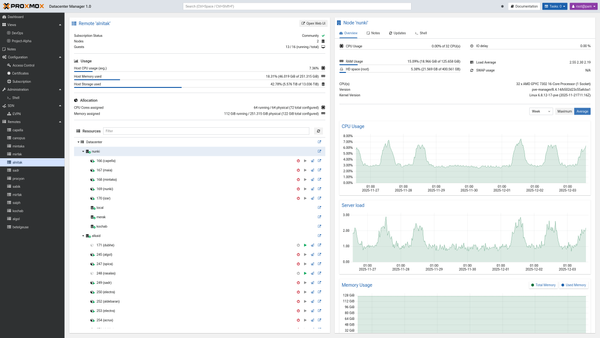
PDM is a perfect dashboard for our Proxmox setup. Perfect for a home lab, but The current version is now 1.0. It's an open-source, centralized solution providing a single pane of glass view overseeing and managing multiple, independent Proxmox based environments.
Alpine
Sometimes you need a small desktop on the cluster to do stuff. Alpine is a pure Linux OS, it's tiny. Adding a desktop, and it's there, a lightweight, minimalistic and customizable Linux experience in a VM. It uses Open RC, not Systemd.